

Introducing Chapter 2 of Accountable
Wojtek Pawlowski ·
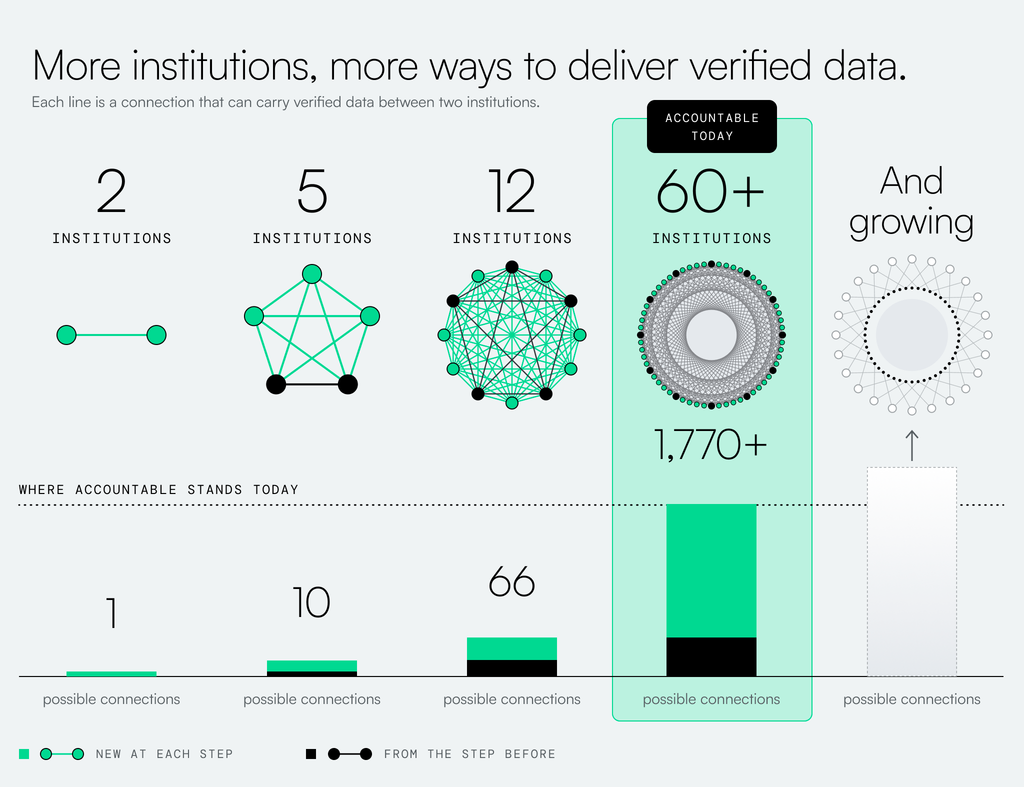
We started Accountable by building the standard for real-time financial verification, and today more than 60 institutions use it, with over 200 integrations into the financial systems they run on.
But our ambition has always been bigger than that: a network where institutions can verify and securely share financial information about themselves and each other, and the infrastructure to launch and operate financial products onchain with that verification built in.
Chapter 2 is where those pieces come together.
The 2 questions every institution asks
Before Accountable, I ran onchain lending to trading firms, and I learned how this market really underwrites a counterparty. Something breaks, a stablecoin depegs, and you start calling your borrowers to ask if they’re still alive.
Every institution moving capital onchain still has to answer two questions: 1) can I trust the counterparty on the other side, and 2) how do I bring my own business onchain? The first usually gets answered with reputation and whatever each counterparty chooses to publish, in its own format and on its own schedule. That’s rarely enough to lend against, so most onchain lending is overcollateralized, which ties up capital and shuts many borrowers out. The second often means building and maintaining your own infrastructure, which is slow and costly, or fitting your business into someone else’s.
Institutions managing other people’s money need better answers to both, and this year raised the bar. Anyone allocating capital in this market has learned what a number they can’t check is worth.
1. Can I trust the counterparty?
Chapter I gave people something they could check for themselves. Data Verification Network (DVN), Proof of Solvency dashboards, Vault-as-a-Service and YieldApp made financial information and products independently verifiable, and the trust they earned came from that confirmation holding up, not from anyone’s word.
But a live balance check answers one specific question: what’s held and owed at the connected sources right now? On its own it doesn’t tell you how that balance was reached, who has actually reviewed it or whether the disclosure is complete. Chapter 2 goes further on each of those, as an extension of the software we built rather than a pivot away from it.
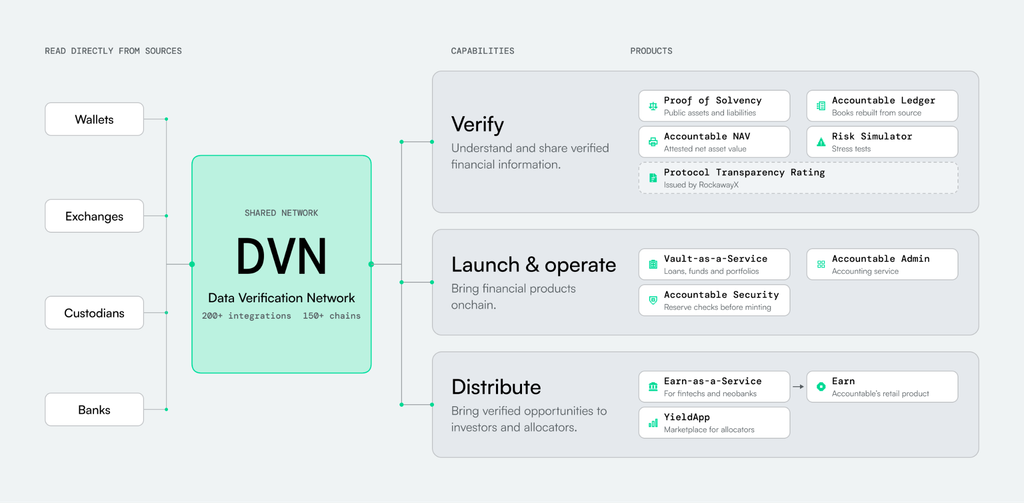
Accountable Ledger reconstructs the history behind a number, with every trade, transfer and fee rebuilt independently from source and reconciled against balances. Accountable Admin adds qualified people who can assess what the numbers mean and stand behind their work. And the Protocol Transparency Rating, with ratings issued by RockawayX, makes the quality of public disclosure visible. It measures what a protocol’s dashboard shows publicly, not whether the protocol is safe.
Each of these is a different kind of evidence. Transparency is a matter of degree, and an allocator should be able to see which kinds are there and decide for themselves whether that’s enough.
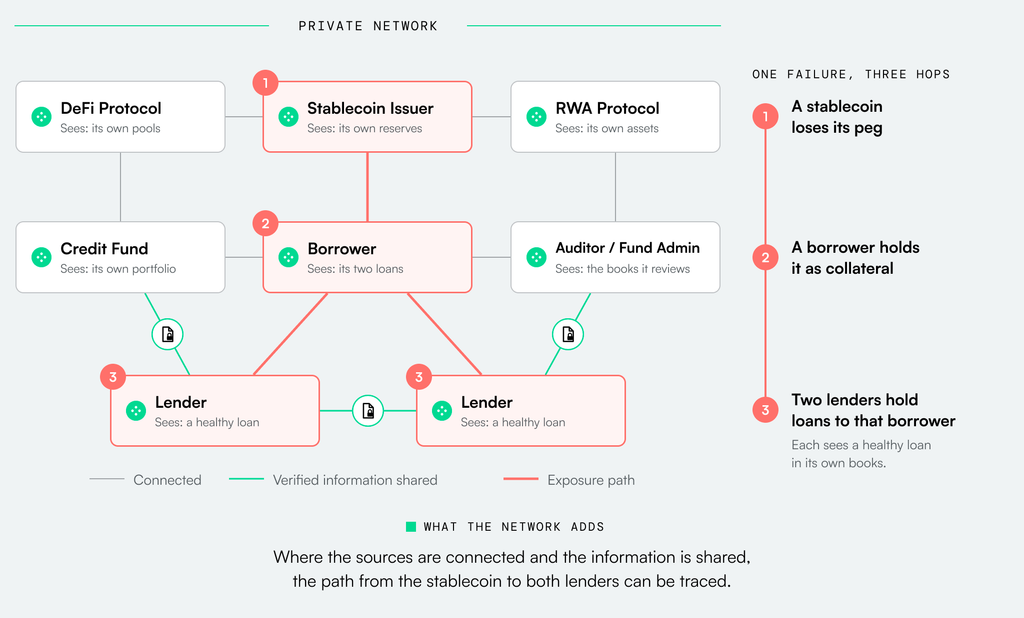
But going deeper into one institution is only half the picture. The other half is seeing it in the context of the market around it, and the institutions it’s connected to. Take two lenders who have each lent to the same borrower. Both see a healthy loan in their own books, but neither sees the other’s exposure, so neither can tell from its own records how much the borrower really owes across the two.
That’s why we’re building a network. When institutions connect their sources and share verified information, overlapping exposures like that can become visible in ways isolated reports can’t show. And it doesn’t require anyone to publish their books. DVN lets institutions prove financial information without exposing the sensitive data underneath, and control who can see what. The picture depends on the sources connected and the information shared, and being clear about those boundaries is part of what makes the information useful. The more institutions connect, the more chances there are to check what one party reports against evidence from another, and to understand how a failure could travel between them.
2. How do I bring my own business onchain?
Now turn the first question around. Once you launch a product onchain, you’re the counterparty someone else has to trust. You need infrastructure that fits how your business actually operates, and your allocators need evidence of what the product holds, how it performs and which rules govern it. Because Accountable already connects to institutions and their financial systems, we can give you both.
Vaults V2 separates the structure of a financial product from the machinery that holds and moves its capital. Institutions can set up products from ready-made templates, anything from a single loan or fund to a portfolio of positions on different terms. The rules sit in the contracts, from which venues can receive idle capital to who can move it and which limits apply, so allocators can inspect them and the contracts enforce them. YieldApp can then bring those products to allocators with their verification attached. Next is our Earn-as-a-Service, so fintechs and neobanks can offer that yield to their own customers.
We’re also building toward verification that decides whether an action can happen at all. Accountable Security applies that to things like stablecoin issuance: a token built with it can’t mint new supply until the required reserve verification is in place, so verification becomes part of how the product operates. More on that soon.
How these pieces belong together
Everything starts with DVN, which reads financial data directly from connected sources and makes it verifiable. The information side helps institutions assess counterparties and explain their own financial position, and the product side lets them launch and operate onchain on the same foundation.
That means a product launched through Accountable can use verified information from the sources its operator already connects, and an institution assessing that product can work from the same evidence, subject to the access it’s been granted.
Every new connection makes the network more useful: more information that can be checked, more relationships that can be reconciled and more products carrying evidence their allocators can actually use.
Where Chapter 2 takes us
Go back to that phone call. When something breaks, the work of understanding your exposure should already have started. You should be able to see what a counterparty has disclosed, where that information came from, how it was checked and which connections could expose you to a failure somewhere else. And when you launch your own product, you should be able to give your allocators that same evidence from day one.
That’s where Chapter 2 takes us, and it’s why our ambition is for Accountable to be the standard for financial verification and the infrastructure to launch and operate financial products onchain. It won’t make fraud or losses impossible, but it makes the truth easier to check and leaves a lot less room to hide.
As always, don’t take our word for it. Hold us accountable.